
( ) Certificate of Origin for Exportation of Beverages number ID.
( ) Certificate issuing country: make sure it is correctly informed.
( ) Exporter: information of the exporter, including full address including zip code and corporate name. Besides, check if the information is in congruency with the other documents (Bill of Landing, Packing List, Commercial Invoice, …).
( ) Manufacturer/Bottler: complete information on the manufacturer/bottler, which must be the same as those stated on the label, including the information of the exporter, including full address including zip code and corporate name. Besides, check if the information is in congruency with the other documents (Bill of Landing, Packing List, Commercial Invoice, …).
( ) Importer/ Ship To: Confirm that the information in the importer field is in accordance with the information below, with full address including zip code, tax ID and corporate name:
CORPORATE NAME..
ADDRESS..
TAX ID..
PHONE..
( ) Transport mode: usually sea, air or road transportation
( ) Unload destiny: inform the final storage destiny, i.e. Navegantes, Itajaí, Santos.
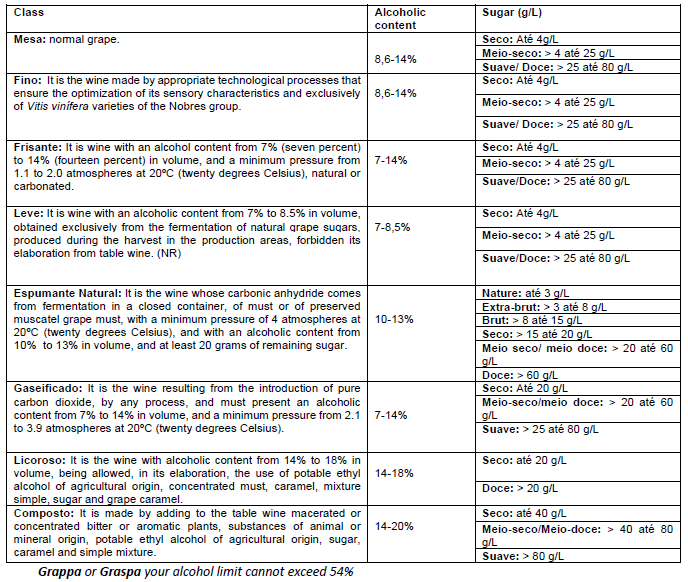
( ) Product denomination – general rule: Wine + Class + Color + Sugar Content + Grape.
*Important: the denomination must be described exactly in the order mentioned in the general rule or in accordance with local legislation – IN DIPOV 01/2019. Example: “Vinho Fino Tinto Seco Malbec”. Grape information is optional, being allowed to mention only one grape variety if it represents at least 75% of the grapes used in its preparation, otherwise it is not allowed to inform the grape varieties in the denomination. There are exceptions to the general rule, for this reason, validate the final description with the importer before issuing the original documents, avoiding problems in Brazil. For example, in the case of Moscato wines, the sugar content cannot be included in the denomination. See below for more details on the general rule:
( ) Brand: must contain ALL other information that appears on the label without its own field in the form, including harvest (if any), special editions, reservation/ gran reserva, etc.
( ) Batch: you cannot confuse the batch number with the harvest, i.e. L12345/2020, make sure that 2020 would actually be part of the batch or not, this is a common mistake among exporters. Important: the certificate must mention only one specific batch. If there are multiple batches, multiple certificates will be required.
( ) Geographical indication: if the label has this information, it is mandatory to include this information in the form. Likewise, if the certificate has the geographical indication, this information must be included in the label.
( ) Type of package: usually box or bottle.
( ) Capacity: must be informed according to the type of package.
( ) Quantity: must be informed according to the type of package
( ) Total volume: must be the sum of the volumes of the batch of this certificate, usually expressed in liters or kilos.
( ) Certificate of Analysis reference number: make sure it is correctly informed.
( ) Signature and stamp of official agency.
FREQUENT MISTAKES in the Certificate of Origin for Exportation of Beverages:
Example 1:
Denomination: VINO BLANCO CHARDONNAY / SECO – 2021
Denomination Errors:
– Denomination without class information: missing expression “FINO”
– Denomination with incorrect sequence: grape before sugar content (“SECO”)
– Denomination with harvest information: “2021” must be allocated in brand
Correct Denomination: VINHO FINO BRANCO SECO CHARDONNAY
Example 2:
Denomination: VINO TINTO CARBENET SAUVIGNON MERLOT / SECO – 2017
Denomination Errors:
– Denomination without class information: missing expression “FINO”
– Denomination with incorrect sequence: grape before sugar content (“SECO”)
– Denomination with more than one grape: it is optional to include only one grape variety if it represents more than 75%, otherwise it is not allowed to inform the grape varieties in the denomination. Alternatively, it is optional to include “Blend” information. If the grape varieties are informed on the label and it is necessary to inform them in the certificate of origin for beverage, it is possible to inform them in the “brand” field in descending order.
– Denomination with harvest information: “2017” must be allocated in brand
Correct Denomination: VINHO FINO TINTO SECO ou VINHO FINO TINTO SECO BLEND
Example 3:

Brand error:
– Brand with information of class and color: the expressions “FRISANTE” and “BRANCO” must be excluded
Example 4:

Denomination Errors:
– Denomination without beverage information: missing expression “VINHO”
– Denomination with geographical indication: “DOP PORTO” must be excluded
– Denomination without class information: missing expression “LICOROSO”
– Denomination without sugar content: missing expression “SECO”
Correct Denomination: VINHO LICOROSO TINTO DOCE
Brand Error:
– Brand with geographical indication: geographical indication should be informed in the specific field, “PORTO-BRA” must be excluded.